Cocoon shock breakout emission from binary neutron star mergers
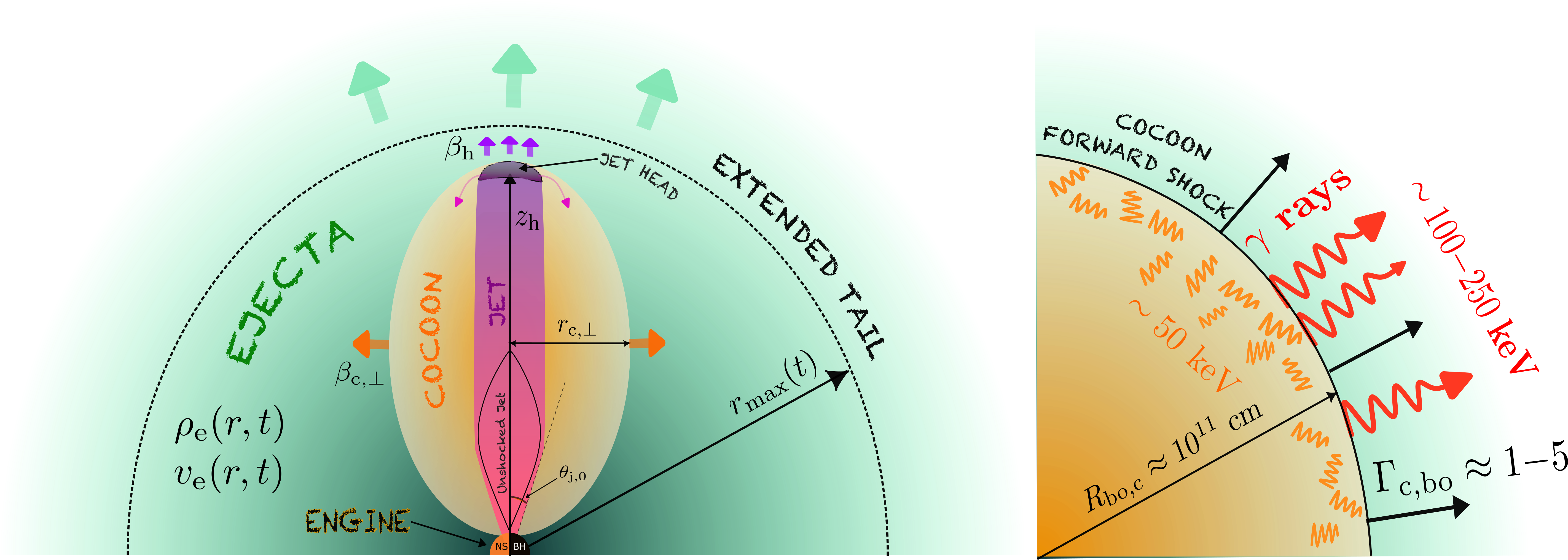
In 2408.15973, we investigated the shock breakout emission produced by the jet/cocoon system launched in a binary neutron star (BNS) mergers. After a coalescence, an engine remnant which may be a black hole or a fast-rotating neutron star is formed. Such an engine may launch a collimated jet along the polar axis. For this jet to efficiently produce observable radiation, it must first propagate through the surrounding dense ejecta produced in the merger. The earliest escaping photons from this interaction correspond to the so-called shock breakout emission. We employed NR simulations spanning multiple binary configurations and equations of state to obtain realistic ejecta density and velocity profiles. Building on these profiles, we developed a semi-analytic model to track jet and cocoon propagation and to compute the resulting shock breakout signal across a range of central engine parameters. Our results show that the shock breakout emission is highly sensitive to the properties of the outermost ejecta layers. In particular, ejecta distributions featuring an extended, fast-moving tail yield predictions consistent with the low-luminosity short gamma-ray burst observed in coincidence with GW170817.
Read more