Magnetic Field Configurations in Binary Neutron Star Mergers I: Post-merger Remnant and Disk
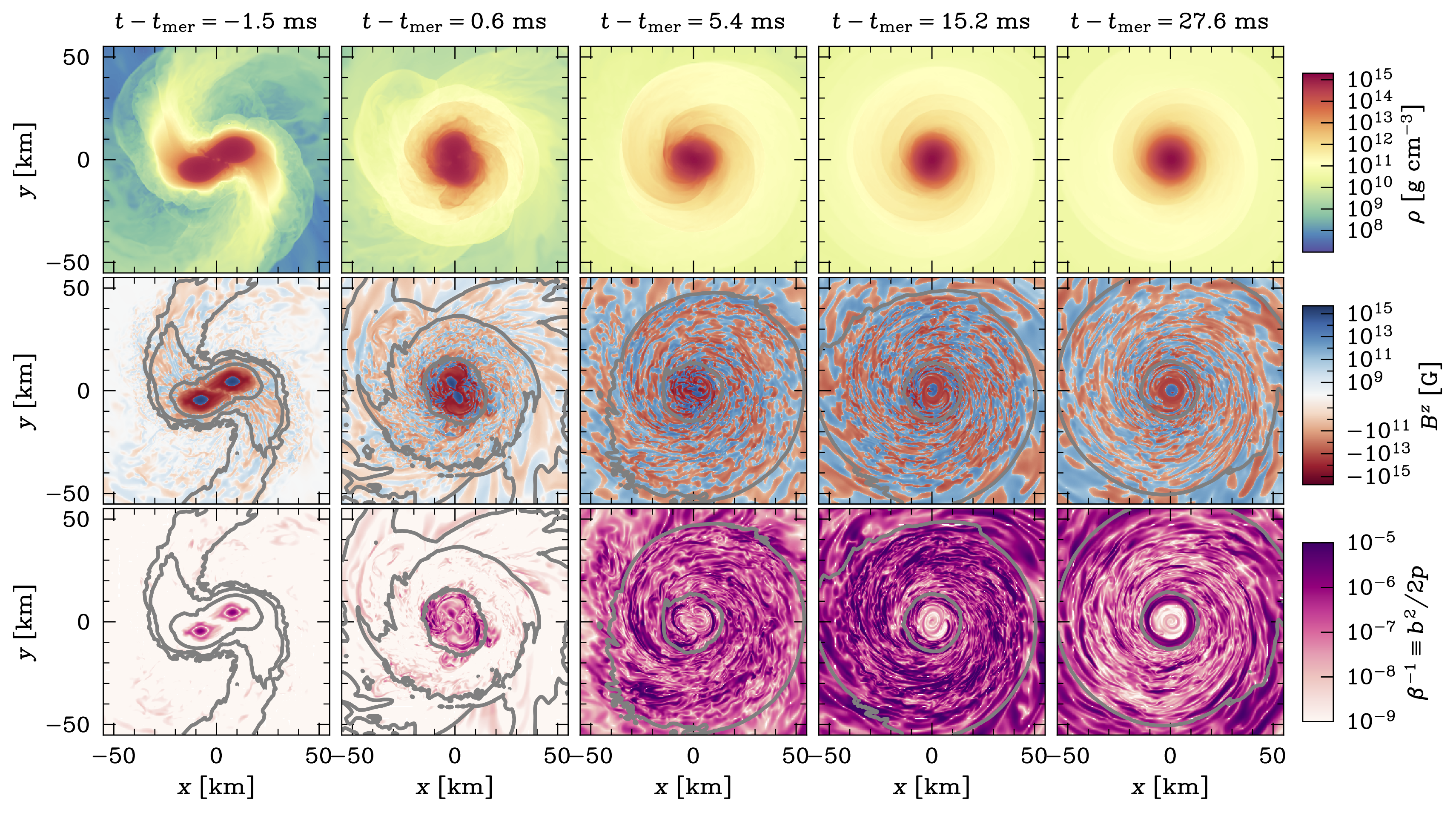
In 2506.17885, we present the first of a set of two companion papers where we analyze a set of general relativistic magnetohydrodynamic (GRMHD) simulations of binary neutron star (BNS) mergers performed with the code GR-Athena++. Our study explores how variations in the pre-merger magnetic field configuration, the nuclear equation of state, and the binary mass ratio influence the magnetic and thermodynamic evolution of the post-merger remnant and its surrounding disk. In addition, we assess the consequences of imposing the commonly adopted equatorial reflection (bitant) symmetry. Magnetic field amplification begins promptly after the stars merge, driven by the Kelvin-Helmholtz instability. At later times, the field continues to evolve under the combined action of differential winding and turbulence, ultimately settling into a predominantly toroidal configuration. Although the field is strongly reprocessed through the merger, the initial magnetic field topology still leaves a measurable imprint on the post-merger configuration and can affect the overall amplification achieved, particularly for the magnetic field strengths typically assumed in the literature and at the finite resolutions feasible for GRMHD simulations. Moreover, we find that enforcing equatorial reflection symmetry partially suppresses turbulence in the vicinity of the midplane, altering the subsequent magnetic field evolution by enhancing its rate of amplification.
Read more